




The government has announced plans to distribute at least 500 million coffee seedlings to farmers this year in a major effort to revive Kenya’s coffee sector and significantly increase production. The initiative forms part of ongoing reforms aimed at boosting coffee farming, improving farmer incomes and restoring the country’s competitiveness in the global coffee market.
The announcement was made by Cooperatives, Micro and Small Enterprise (MSMEs) Cabinet Secretary Wycliffe Oparanya during a coffee reforms sensitisation tour at Urru Stadium in Tigania West Constituency, Meru County. The meeting brought together coffee farmers, cooperative leaders and government officials to discuss measures intended to transform the sector.
Kenya’s coffee industry has experienced declining production over the years due to ageing coffee bushes, inadequate extension services, limited access to quality planting materials and other production challenges. The government believes that expanding acreage under coffee and replacing old bushes with improved varieties will help reverse the trend and increase yields.
“We already have the seedlings, including 300 million from Kenya Planters Cooperative Union and another 200 million sourced from Uganda. We want farmers to increase acreages of coffee and, in return, increase our production,” said Mr Oparanya.
The Cabinet Secretary said the seedlings are ready for planting and are only awaiting distribution to farmers. He noted that the government has already secured the planting materials and is finalising the process to ensure farmers receive them ahead of the planting season.
Distribution Through Cooperatives
Oparanya said the government will distribute the seedlings through primary coffee cooperatives to ensure the exercise is well coordinated and reaches genuine coffee farmers. He urged the cooperatives to work closely with county governments by submitting proposals indicating the varieties of seedlings required before the allocation exercise begins.
“Distribution will only be done through primary cooperatives and that is why we want them to write proposals to know their specific need, since we have a variety of seedlings,” said Mr Oparanya.
According to the CS, the proposals will help the government determine the specific coffee varieties suitable for different regions, allowing farmers to receive seedlings that are best adapted to their local conditions. He said this approach will improve survival rates and maximise production once the seedlings are planted.
The government is also moving to address the shortage of extension officers, a concern that was repeatedly raised by farmers and stakeholders during the sensitisation forum. Many farmers argued that inadequate technical support has contributed to poor farming practices and declining productivity.
Responding to the concerns, Oparanya announced plans to recruit at least two specialised coffee extension officers in every ward across the country’s 47 counties. The officers will focus exclusively on coffee farming and will complement county government efforts in supporting farmers.
“The issue of extension officers lies with the County Governments, but since I understand the issues, they are facing, we have decided to employ these special officers who will include one male and female from all the wards, so that we can improve the state of coffee farming in the country,” said Mr Oparanya.
He added that the officers will undergo specialised training before deployment to equip them with the knowledge needed to guide farmers on modern coffee production techniques, pest and disease management, soil fertility and quality improvement.
“The selected officers will be taken to KPCU for training on coffee issues, in order to offer informed services to farmers,” said Mr Oparanya.
Targeting Higher Coffee Output
Oparanya reaffirmed the government’s commitment to implementing reforms promised by President William Ruto to revitalise the coffee sector. He urged farmers to support the reforms, saying they are designed to restore confidence in the industry and improve returns for growers.
“The government is committed to implement various reforms to revive coffee farming just as promised by President William Ruto, during his campaigns. You should not listen to propaganda which is peddled by those who have been swindling your money all along,” said Mr Oparanya.
Principal Secretary for the State Department for Cooperatives Patrick Kilemi said the seedling distribution programme is intended to substantially increase coffee production, with the Coffee Research Institute (CRI) and New KPCU taking responsibility for propagating high-yielding coffee varieties.
He said Kenya continues to lag behind neighbouring coffee-producing countries despite producing some of the world’s finest coffee, making increased investment in quality planting materials necessary.
“Last year, Kenya produced 50,000 metric tons, while Uganda produced 400,000 metric tons and Ethiopia produced 750,000 metric tons of coffee.
We want our farmers to plant recommended coffee seedlings as we target to increase our production by more than ten times. Properly planted and well-nurtured coffee can produce more than 40 kilos per bush,” said Mr Kilemi.
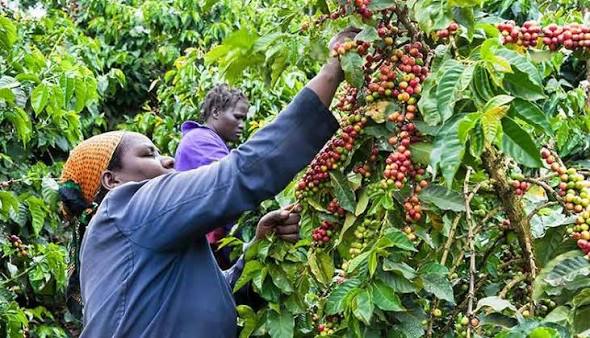
Kilemi attributed the country’s low production largely to ageing coffee bushes, noting that a coffee plant remains optimally productive for about 20 years before yields begin to decline. He encouraged farmers to gradually replace old trees with certified high-yielding varieties to improve productivity.
The reforms are expected to strengthen Kenya’s coffee value chain by increasing production, expanding access to extension services and promoting the adoption of improved coffee varieties. If fully implemented, the programme is expected to raise farmer incomes, enhance export earnings and restore the country’s position as one of Africa’s leading coffee producers.