

Coffee farmers are set to earn higher returns after prices surged at the first Nairobi Coffee Exchange (NCE) auction following the mid-year recess, underscoring sustained global demand for premium Kenyan coffee despite a sharp decline in supply.
Sale 30, held at Wakulima House in Nairobi on Wednesday, generated Sh345 million after 6,622 bags weighing 412,562 kilogrammes were traded.
Reduced volumes did little to dampen buyer interest, with the average auction price climbing significantly compared to the final sale before the break.
Data released by the Nairobi Coffee Exchange shows coffee sold at an average of Sh41,864 per 50-kilogramme bag, equivalent to Sh836 per kilogramme of clean coffee.
Volume traded declined by nearly 48 percent from the 792,877 kilogrammes offered during Sale 29 before the recess. Strong competition among buyers, however, pushed average prices up by Sh8,474 per bag, representing a 25 percent increase.
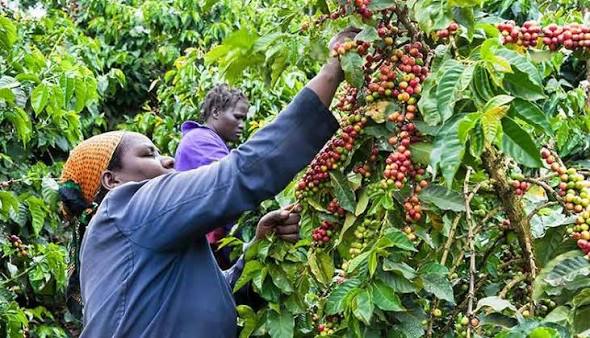
Higher auction prices are expected to directly benefit growers by increasing the estimated cherry payout from approximately Sh103 to Sh129 per kilogramme, offering coffee farmers improved earnings as deliveries continue.

Nyeri And Murang’a Factories Dominate Premium Coffee Sales
Factories from Nyeri and Murang’a counties dominated the premium price category, reaffirming the reputation of central Kenya as the country’s leading producer of high-quality Arabica coffee.
Kieni Factory in Nyeri posted the highest price of the auction after its Grade AA coffee sold for Sh55,302 per 50-kilogramme bag.
Alliance Berries marketed the coffee, while leading coffee buyer C. Dormans secured the lot.
Kathiguni Factory followed closely after achieving Sh55,043 per bag, while Kiiriangoro Factory in Murang’a realized Sh54,914.


Muthaite Factory earned Sh54,655, with Gitugu Factory completing the top five after selling coffee at Sh54,397 per bag.
Premium Grade AA coffee continued to attract the strongest prices in the market.
Buyers purchased 516 bags of Grade AA coffee valued at approximately Sh32.3 million, reflecting continued international demand for Kenya’s highest-quality beans.
Grade AB, the country’s largest coffee category by volume, accounted for 2,941 bags and generated Sh176.8 million, making it the biggest contributor to the auction’s overall value.
Nine licensed marketing agents participated in Sale 30, collectively representing coffee factories from across the country.
New Kenya Planters Cooperative Union (New KPCU PLC) handled the largest volume during the auction, marketing 2,219 bags worth Sh117.6 million at an average price of Sh42,984 per bag.
Alliance Berries ranked second after selling 1,402 bags valued at Sh78.1 million.
Kipkelion Brokerage Company marketed 951 bags worth Sh49.9 million, while KCCE Marketing Agency traded 730 bags, generating Sh30.2 million.
International Buyers Maintain Strong Demand
Competition among international coffee buyers remained intense despite lower supplies reaching the auction floor.
Seventeen licensed dealers participated in the trading session, with the five largest buyers purchasing approximately 84 percent of all coffee offered.
Ibero Kenya emerged as the biggest buyer by volume after acquiring 1,569 bags valued at Sh87.9 million.
C. Dormans spent the highest amount during the auction, purchasing 1,478 bags worth Sh92.3 million, further cementing its position among the country’s leading exporters of premium Kenyan coffee.
Global commodities trader Louis Dreyfus purchased 1,394 bags valued at Sh70.5 million, while Taylor Winch acquired 562 bags worth Sh33 million.
Global Mark Foods completed the top five buyers after purchasing 577 bags valued at Sh11.4 million.
Market performance at the first auction after the recess reflects sustained international appetite for Kenyan coffee, particularly premium grades that continue to command attractive prices in export markets.
Industry stakeholders are likely to welcome the higher prices, especially after recent concerns over fluctuating global commodity markets and production costs affecting growers.
Improved auction returns could encourage farmers to invest more in quality improvement, better crop management and increased production ahead of the next harvest season.
Continued demand from international buyers also reinforces Kenya’s reputation as a producer of specialty Arabica coffee, with quality remaining the key driver of premium prices.
Attention will now shift to upcoming Nairobi Coffee Exchange sales to determine whether the price rally can be sustained as larger coffee volumes gradually return to the market following the mid-year break.